The Barakah Circular Economy is a community-centered economic model developed by Sukun Academy and Sukun Ecovillage.
It is designed to restore trust, fairness, and ecological balance in the way people live, work, and exchange value.
In today’s world, wealth often flows away from communities, competition replaces cooperation, and land becomes a commodity rather than a shared trust. The Barakah Economy seeks to reverse this pattern by creating a system where resources circulate locally, work is honored, and prosperity is shared.
At the center of this model is Waqf, a community land trust that holds land and core assets in permanent stewardship for the benefit of people and nature.
This ensures that the land cannot be privatized or speculated upon, allowing it to remain a source of continuous benefit (ṣadaqah jāriyah) for present and future generations.
Sukun Academy and Sukun Ecovillage function together as a learning and living ecosystem:
Together they form a circular community economy, where knowledge, resources, and care flow continuously between learning and practice.
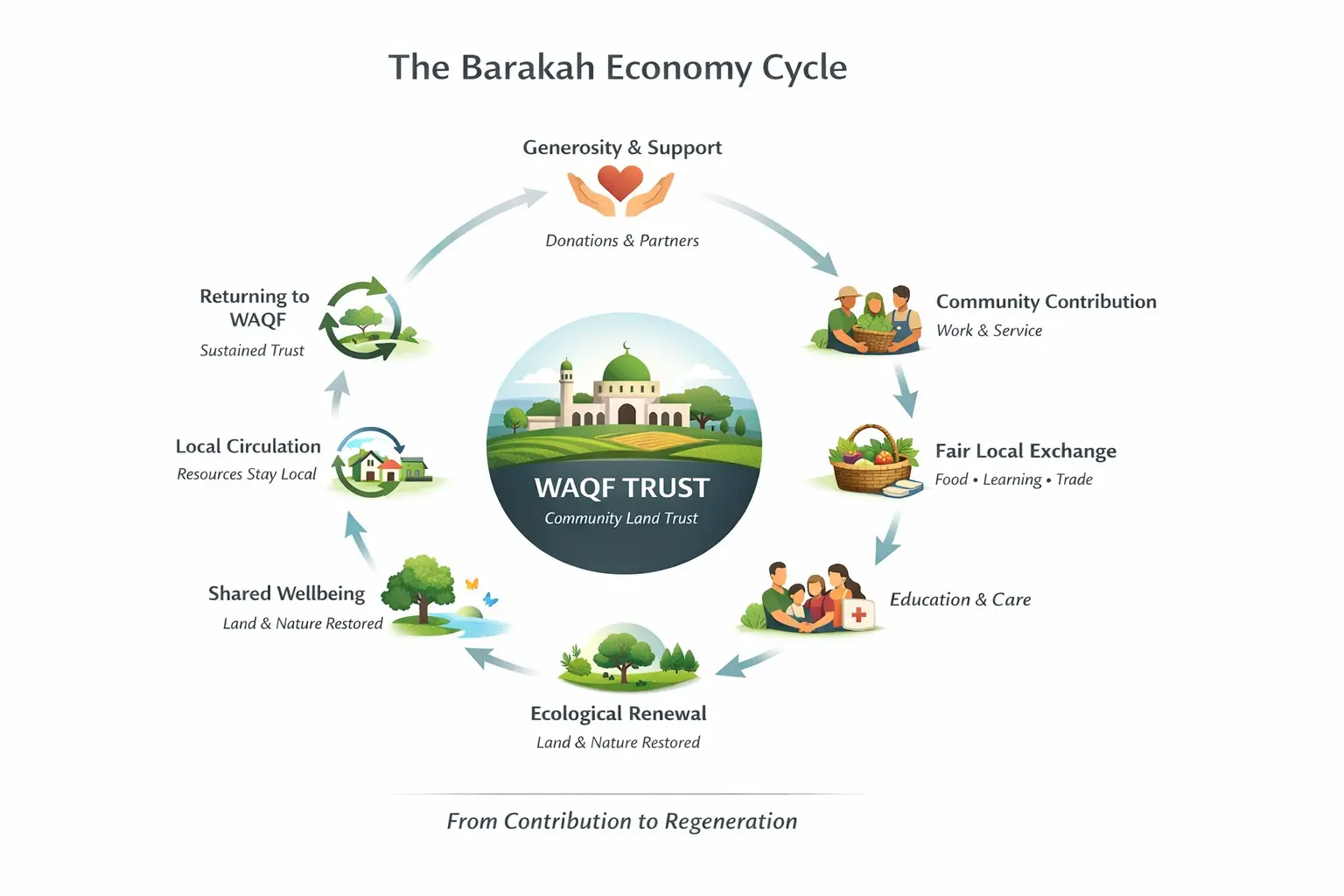
In the Barakah Economy, value is rooted in contribution rather than accumulation.
People support the community through work, knowledge, service, and generosity. These contributions are recognized through transparent community systems that help coordinate exchange, collaboration, and shared benefit.
This approach encourages:
Decisions within the community follow the principle of Shūrā (consultation), ensuring transparency, participation, and ethical balance. The community collectively guides how resources are used, how projects grow, and how benefits are shared.
The goal of the Barakah Economy is not simply growth, but regeneration.
Resources circulate through giving, learning, producing, and caring for the land, allowing prosperity to expand while strengthening community bonds and ecological health.
In this way, economic life becomes an act of stewardship — where work becomes service, exchange becomes cooperation, and prosperity carries barakah, a blessing that grows as it is shared.